
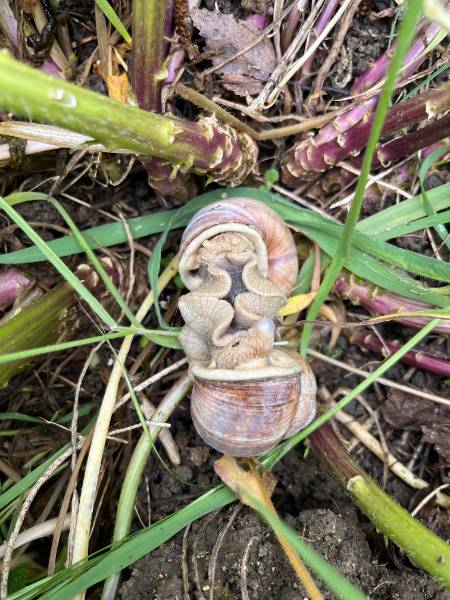
Roman Snails?
| Tim Crisp |
👍
3
Fri 22 May, 16:11 I think the future of the Roman snails is in safe shells...
|
| Deborah Longshaw |
👍
2
Fri 22 May, 10:14 Thank you for this post - I saw two (which I presumed to be African Snails since they were so large) disappearing into the undergrowth in the first green area at the top of Ticknell Piece Road, both look incredibly healthy. |
| Simon Fenn |
👍
5
Wed 20 May, 09:50 I'm told, by someone who lectures and guides at the North Leigh Roman villa (East End), that the local population of Roman snails probably were first introduced at the villa (for food); that they're still there, to be seen especially near the river end of the site, and that (evidently, from where they've got to over the last 2,000 years) they don't spread very fast... |
| Helen Holwill |
👍
5
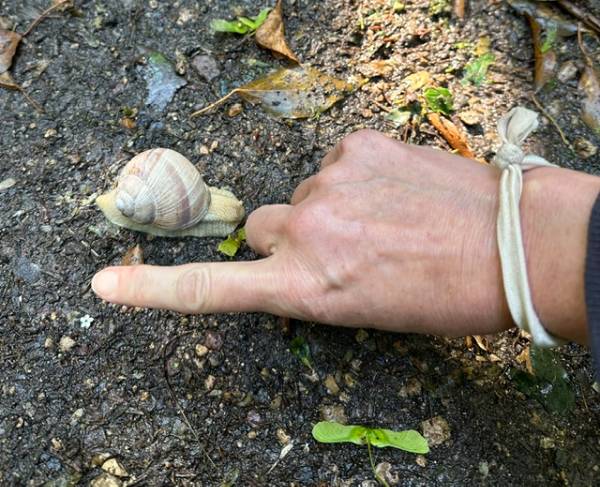
Wed 20 May, 09:27 (last edited on Wed 20 May, 09:28) Here's a photo of one I saw in Quarry Lane last June. Finger for scale, rather than telling it where to go. (Although it does look like I inadvertently caused an emergency stop.) |
|
Richard Fairhurst
(site admin) |
👍
6
Wed 20 May, 08:25 I am amused that ChatGPT appears to have decided to write a comment about parking in the snails thread. |
| Christine Battersby |
👍
4
Tue 19 May, 17:19 Just because you often see them round here, it doesn't mean that Roman snails aren't very rare. The Cotswolds is one of their few primary habitats in the UK, along with the Chilterns and the North Downs. Having said that, I think people often mistake large garden snails for Roman snails, but when you see a large Roman snail in, for instance, the Priory Gardens it's a bit of a shock as they are extremely large -- and easily mistaken for a small rock! Large garden snails often have a zigzag pattern on their shells, Roman snails do not. I have lots of different types of snail in my garden, including many Ramshorn snails in my pond, but alas no Roman snails. |
| James Styring |
👍
Tue 19 May, 15:48 You can see them quite often in Stonesfield Woods too. They can't be that rare? |
| Steven Fairhurst Jones |
👍
1
Tue 19 May, 14:41 We saw five of them on the trackside verge at Finstock station this morning when the train stopped there. |
| Susie Burnett |
👍
2
Mon 18 May, 23:16 I have seen a few in the last couple of weeks (after the rain) in the field before the river at Fawler and along the river path up to the bridge |
| Graham Wisker |
👍
7
Mon 18 May, 18:33 What have the Romans ever done for us |
| john h |
👍
1
Mon 18 May, 16:27 They are still causing damage to a garden in the area around the Church. John H |
| Alex Meakin |
👍
2
Mon 18 May, 14:04 I find a lot them particularly hanging around my various well established nettle patches in my garden. However, this is in a damp spring riddled chalk valley, in northern Normandy. |
| Alan Wilson |
👍
1
Mon 18 May, 13:57 I'm intrigued to read this. We get these very large pale snails in our garden every year (last one seen only yesterday) and it never occurred to me that they were particularly rare. Is there another very large species of snail I might be confusing it with? A quick web search suggests that the size is a reliable indicator.... |
| Simon Walker |
👍
3
Mon 18 May, 10:07 A couple of years ago, there were quite a few climbing up the trees on either side of the Cornbury drive between the road and the railway bridge. Last year, I saw maybe a couple; this year, none yet. I wonder if it has been too dry for them - both last year and this, the spring has been dry, and presumably they like it damper when they open the front door after winter and set off wandering again. It will be interesting to see if a few days' rain brings them out. |
| Katie Ewer |
👍
2
Mon 18 May, 09:06 When I lived in Fawler, we used to see them along the Evenlode Lane regularly. |
| Tony Graeme |
👍
3
Mon 18 May, 07:28 (last edited on Mon 18 May, 08:13) When I was leading the annual Boundary walk we saw them most years along the stretch from N Lodge towards Fawler. When they were made a protected species in 2008 I ‘instructed’ the walkers that they needed to be extra careful not to tread on them. |
| Andrew Chapman |
👍
1
Mon 18 May, 07:05 I used to see them on the Cornbury drive every year, also sometimes near the railway bridge at Fawler – haven't seen them for a two or three years now though. |
| Hannen Beith |
👍
1
Sun 17 May, 22:17 I've occasionally seen one in Cornbury Park. Helix pomatia. Introduced by the Romans for eating. They are now very rare. Since 2008, the Roman snail has been listed under the Wildlife and Countryside Act 1981, which makes it an offence to intentionally kill, injure, or remove the species from its natural habitat. |
| John Lanyon |
👍
1
Sun 17 May, 19:55 Many years ago, I would quite often find large white snails with white shells down by the station prior to the rebuilding of the second platform, particularly after heavy rain. I was told they were Roman snails and a protected species. Has anyone spotted them recently in our neighbourhood? |
You must log in before you can post a reply.